Colorful Cliffs & Cobbled Dreams: A Local’s Take on Cinque Terre’s Soul
You know that feeling when a place just hits different? That’s Cinque Terre. Nestled along Italy’s rugged coast, these five cliffside villages aren’t just postcard-perfect—they’re alive with character. What makes them unforgettable isn’t just the sea views or pesto (though, yes, the pesto is fire). It’s the way houses stack like LEGO bricks, painted in sun-faded hues, clinging to stone. This is architecture born from necessity, shaped by history, and screaming with charm. Let me take you inside the bones of this UNESCO wonder.
The First Glimpse: Arrival in Cinque Terre
For most visitors, the first view of Cinque Terre arrives through the window of a train winding along the Ligurian coast. As the tracks hug the shoreline, sudden bursts of color emerge from between rocky outcrops—clusters of buildings stacked vertically, defying gravity with an almost theatrical flair. The journey itself becomes part of the experience, a slow unveiling of a landscape where human habitation and natural terrain are inseparable. There is no grand entrance, no sweeping boulevard—just a quiet descent from the station into a maze of cobbled alleys and sea-scented air.
This dramatic arrival sets the emotional tone. There’s a sense of awe, yes, but also intimacy. The villages do not announce themselves with noise or scale. Instead, they whisper through the rustle of laundry in the breeze, the distant clink of dishes from a hillside trattoria, the soft echo of footsteps on stone. Travelers often report a moment of stillness upon arrival—a pause, as if stepping into a world operating on a different rhythm. It’s not just the beauty that strikes them, but the resilience embedded in every wall and stair.
The fragility of these settlements is palpable. Perched on near-vertical slopes, exposed to wind, salt, and seasonal rains, the villages appear almost precarious. Yet they have endured for centuries. This contrast—between delicacy and endurance—creates a deep emotional resonance. Visitors don’t just see a destination; they feel the weight of time, the quiet courage of generations who chose to build life here, against all odds. It is this invisible strength, more than the colors or the views, that lingers long after departure.
A Village, a Story: Understanding the Five Terres
Cinque Terre—literally “Five Lands”—refers to the five historic fishing villages that stretch along a narrow 12-kilometer coastline: Monterosso al Mare, Vernazza, Corniglia, Manarola, and Riomaggiore. Though unified by geography, culture, and UNESCO designation, each village maintains a distinct architectural personality shaped by its unique topography and history. Together, they form a living mosaic of adaptation, where local solutions reflect both communal wisdom and individual character.
Monterosso, the largest and most accessible, offers a rare stretch of sandy beach and a blend of medieval and modern structures. Its old town is tightly clustered, with narrow lanes and vaulted passageways, while newer developments extend slightly inland. Vernazza, often considered the most picturesque, rises around a natural harbor, its central piazza opening directly to the sea. The church of Santa Margherita d’Antiochia crowns the waterfront, its bell tower a vertical anchor in the village’s composition.
Corniglia stands apart—literally. Perched atop a rocky promontory 100 meters above sea level, it is the only village not directly on the water. Reaching it requires climbing 382 steps—or taking a shuttle from the train station below. This elevation gives it a quieter, more contemplative atmosphere, with terraced gardens and panoramic views. Manarola, by contrast, is a cascade of warm-toned buildings tumbling toward the sea, its famous skyline often photographed at dusk. Riomaggiore, the southernmost village, unfolds along a deep cleft in the cliff, its houses stacked in a zigzag pattern up both sides of the ravine.
Despite these differences, all five share a common architectural DNA: compact footprints, shared walls, minimal setbacks, and a reliance on local materials. There is no room for excess. Every square meter is accounted for, every structural decision shaped by necessity. The result is not uniformity, but harmony—a collection of solutions to the same fundamental challenge: how to live on the edge.
Built to Survive: The Genius of Terraced Construction
The foundation of Cinque Terre’s architecture lies in its terraces. Carved painstakingly into the steep hillsides over centuries, these flat platforms serve as the literal ground upon which homes, vineyards, and pathways rest. Without them, large-scale habitation would be impossible. The terracing system is not merely decorative—it is a feat of engineering born of survival, designed to create usable space while preventing erosion and landslides.
These terraces are held in place by dry-stone walls, constructed without mortar from locally quarried rock. The stones are carefully stacked, interlocking to form flexible yet stable barriers that can shift slightly with ground movement without collapsing. This technique, passed down through generations, allows the walls to breathe and adapt to environmental stress. In heavy rains, when water pressure builds, the walls absorb and redistribute force, reducing the risk of catastrophic failure.
Beyond stability, the terraces play a crucial role in agriculture. They capture soil and retain moisture, enabling the cultivation of grapes, olives, and vegetables on otherwise unusable slopes. The famous local white wine, Sciacchetrà, is produced from grapes grown on these terraced vineyards, a testament to human ingenuity transforming adversity into abundance. Each terrace is both a structural platform and a productive unit, blending utility with sustainability.
Maintenance is constant and community-driven. Stone walls require regular inspection and repair, especially after storms. Local families, often working together, rebuild collapsed sections using traditional methods. In recent years, volunteer programs and conservation groups have joined these efforts, recognizing that the survival of the villages depends on preserving this ancient system. The terraces are not relics—they are living infrastructure, maintained by hands that understand their value.
Houses That Defy Gravity: Structural Adaptations
The homes of Cinque Terre are marvels of vertical living. With limited horizontal space, buildings rise upward, often reaching four or five stories on plots no wider than a few meters. This verticality is not just a response to space constraints—it is a calculated strategy for stability. Tall, narrow structures distribute weight more evenly across the terraced foundations, reducing lateral pressure on the slopes.
Shared walls are a defining feature. Adjacent buildings are often fused, creating continuous blocks that function as single structural units. This interconnectedness enhances rigidity, helping the entire row resist seismic shifts and wind loads. Buttresses—thickened sections of wall at corners or midpoints—add further reinforcement, particularly on lower levels where stress is greatest. Vaulted cellars, carved into bedrock or built with stone arches, serve as both storage and stabilizing anchors, their mass helping to ground the structures above.
One of the most striking aspects is the use of color. While often celebrated for its aesthetic appeal, the vibrant paint on Cinque Terre’s houses serves practical purposes. Lighter shades reflect sunlight, reducing heat absorption in summer months. Colors also aid in orientation—residents and visitors alike use hue as a visual cue to navigate the labyrinthine alleys. Over time, families have maintained distinct shades, creating a patchwork identity that is both functional and deeply personal.
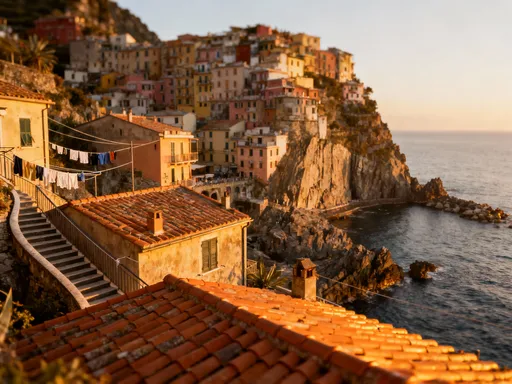
Materials are chosen for durability and availability. Stone forms the base, brick or rubble masonry the upper levels, and timber—often chestnut or oak—for beams and floors. Roofs are typically covered in curved terracotta tiles, designed to shed rain efficiently while withstanding salt corrosion. Every element is selected not for fashion, but for performance in a harsh, exposed environment.
Living on the Edge: Windows, Doors, and Street Life
The placement of doors and windows in Cinque Terre is anything but arbitrary. Each opening is strategically positioned to maximize natural light and ventilation while capturing sea breezes that cool homes in summer. South- and west-facing windows dominate, angled to harness the sun’s warmth in winter. Shutters—usually green or blue—are functional as much as decorative, providing shade, privacy, and protection during storms.
Small balconies, often no larger than a meter deep, are common features. Built from stone or metal, they serve multiple purposes: drying laundry, growing herbs in terracotta pots, or offering a private perch for morning coffee. These modest spaces extend the living area without requiring additional footprint. Laundry lines strung between buildings are not signs of clutter, but evidence of daily life—colorful fabrics fluttering like flags, adding rhythm and movement to the streetscape.
The narrow alleys—called *caruggi*—function as more than just passageways. They are social corridors where neighbors exchange greetings, children play, and elders sit on stone benches in the afternoon sun. Their tight width creates shade in summer and acts as a windbreak in winter, moderating microclimates within the villages. The winding paths also slow foot traffic, encouraging a pace that feels deliberate and unhurried.
Street life unfolds in layers. Ground-floor doors open directly onto the alleys, blurring the line between private and public. A fisherman mending nets, a baker carrying flour, a grandmother watering geraniums—these moments are not staged for tourists, but part of the fabric of daily existence. The architecture supports this intimacy, fostering a sense of community that is increasingly rare in modern urban environments.
Roofs, Steps, and Hidden Systems
Above the colorful facades lies a network of rooftops that play a critical role in the villages’ resilience. The characteristic curved terracotta tiles are not only visually cohesive but highly functional. Their shape allows rainwater to flow quickly to gutters and downspouts, minimizing pooling and leakage. The tiles are also resistant to salt erosion, a vital trait in a coastal environment where sea spray penetrates deep inland.
Beneath the roofs, attic spaces are often ventilated to prevent moisture buildup, which can weaken wooden beams over time. In older homes, these spaces were used for drying herbs or storing fishing gear—multi-use design being a hallmark of Cinque Terre’s architecture. Chimneys are built with care, their placement ensuring smoke disperses without affecting neighboring homes, a consideration in such close quarters.
The staircase system is perhaps the most vital piece of infrastructure. With no room for roads, stairs connect every level of the villages—linking homes, terraces, and public spaces. Some are wide and ceremonial, others narrow and steep, carved directly into rock. They are maintained by municipal crews and residents alike, with repairs often funded through local cooperatives. The steps are not just functional—they are part of the experience, each ascent offering a new perspective, a different view of sea and sky.
Less visible but equally important are the drainage and water collection systems. Many homes feature cisterns that capture rainwater for non-potable uses like gardening or cleaning. Drainage channels, built into alleyways and terraces, direct runoff away from foundations, reducing erosion. These systems, though often hidden, are essential to the long-term survival of the villages, especially during the heavy autumn rains that can trigger landslides.
Preservation in Progress: Modern Challenges, Traditional Solutions
Today, Cinque Terre faces unprecedented pressures. Overtourism—over two million visitors annually—has strained infrastructure, accelerated wear on footpaths, and increased demand for services. The very popularity that sustains the local economy also threatens the delicate balance that has allowed these villages to endure. Foot traffic erodes ancient steps, waste management systems are overwhelmed, and rising property values push out long-time residents.
Environmental challenges compound these issues. Climate change has brought more intense rainfall events, increasing the risk of landslides. In 2011, severe storms caused devastating floods and mudslides, damaging homes and closing trails for months. Since then, monitoring systems have been enhanced, and emergency response plans updated, but the vulnerability remains.
In response, preservation efforts have intensified. Restoration projects prioritize the use of original materials and traditional techniques. When a wall collapses, it is rebuilt with dry-stone methods, not concrete. When a roof is replaced, terracotta tiles are sourced from regional producers who maintain historical standards. The goal is not to freeze the villages in time, but to ensure evolution respects their essence.
Community stewardship is central to this work. Local families, many with roots stretching back centuries, remain deeply involved in maintenance and decision-making. Cooperatives manage vineyards, guide tours, and run guesthouses, ensuring that economic benefits stay within the region. Educational programs teach younger generations about traditional building skills, ensuring continuity of knowledge.
Regulations limit new construction and commercial development. The Cinque Terre National Park, established in 1999, oversees conservation efforts, balancing access with protection. The Cinque Terre Card, which funds trail maintenance and public transport, encourages responsible tourism. These measures reflect a growing awareness: that preservation is not just about saving buildings, but about sustaining a way of life.
Final Reflection: More Than Just Pretty Facades
Cinque Terre’s beauty is undeniable, but it is not superficial. Behind the vibrant facades lies a story of resilience, adaptation, and harmony. These villages are not museum pieces—they are living, breathing communities shaped by centuries of dialogue between people and place. Their architecture is not merely aesthetic; it is a testament to human ingenuity in the face of limitation.
The deeper lesson of Cinque Terre is one of balance. It shows how design can respond to nature without dominating it, how tradition can coexist with progress, and how small spaces can hold immense meaning. In a world increasingly defined by speed and scale, these villages offer a quiet alternative—a reminder that sustainability, community, and beauty can grow from necessity.
For travelers, the call is clear: visit with respect. Walk the trails gently, support local businesses, and pause long enough to listen to the rhythm of daily life. Do not treat the villages as backdrops for photographs, but as homes filled with history and heart. Carry away not just memories, but a sense of responsibility.
As the sun sets over the terracotta rooftops, casting golden light on weathered walls, there is a moment of stillness. The sea murmurs below, the air cools, and the colors deepen. In that quiet, Cinque Terre reveals its soul—not in grand gestures, but in the quiet endurance of stone, the resilience of community, and the timeless dialogue between land and life.