You Won’t Believe What I Saw Hiking in Yellowstone
Hiking in Yellowstone isn’t just walking through nature—it’s stepping into a living, breathing world where steam rises from colorful pools, bison roam freely, and waterfalls crash in remote canyons. I went seeking views, but found something deeper: pure, raw connection. The trails here don’t just lead to overlooks—they reveal moments that stick with you long after you’ve left. If you’ve ever wanted to feel truly alive, this is where to start.
Why Hiking Is the Best Way to Experience Yellowstone
Yellowstone National Park spans over 2.2 million acres across Wyoming, Montana, and Idaho, a vast wilderness where roads cover only a fraction of the terrain. While scenic drives offer breathtaking glimpses, they can’t deliver the intimacy and immersion that hiking provides. Trails wind through thermal basins, alpine meadows, and river valleys—places vehicles were never meant to go. When you hike in Yellowstone, you’re not just observing nature; you’re moving through it, sensing it, becoming part of its rhythm. This slow, deliberate mode of travel allows for a deeper appreciation of the park’s complexity and beauty.
Walking on foot heightens every sense. The earth beneath your boots may be warm from underground geothermal activity, a subtle reminder that Yellowstone sits atop one of the world’s largest active volcanic systems. You might catch the sharp, mineral-rich scent of sulfur rising from a fumarole or hear the distant bugle of an elk echoing through a pine forest. These sensory details—often lost from a car window—become central to the experience. You notice the way sunlight filters through lodgepole pines, the crunch of volcanic rock underfoot, and the sudden stillness when a herd of bison pauses ahead on the trail. These are the moments that define a true Yellowstone adventure.
Compared to guided bus tours or shuttle rides, self-guided hikes offer unmatched freedom. You control the pace, the stops, and the direction. While ranger-led programs provide valuable insights, independent hiking allows for personal discovery. There’s a unique satisfaction in navigating a trail map, choosing your route, and stumbling upon a hidden hot spring or an unexpected overlook. This autonomy fosters a deeper connection with the landscape. At the same time, it’s important to balance freedom with responsibility—staying on marked trails, respecting wildlife, and carrying essential safety gear. When done thoughtfully, hiking becomes not just a way to see Yellowstone, but a way to understand it.
Choosing the Right Trails for Your Level and Interests
One of the greatest strengths of Yellowstone’s trail system is its diversity. With over 900 miles of hiking paths, there’s a route suited to nearly every ability and interest. For those new to hiking or traveling with children, easy trails like the Fairy Falls boardwalk offer gentle, accessible walks through vibrant thermal areas. This 1.6-mile round-trip trail leads to a 200-foot waterfall and passes close to the famous Grand Prismatic Spring’s southern edge. The boardwalk protects both visitors and the delicate microbial mats, making it a safe and educational choice. These shorter hikes provide stunning views without requiring extensive physical preparation.
For intermediate hikers, the Mystic Falls Loop presents a rewarding challenge. At about 2.4 miles with moderate elevation gain, this trail combines forested paths with open viewpoints and ends at a 70-foot cascade. What sets it apart is the option to extend the hike by climbing a steep stone staircase to an overlook above the falls, offering a dramatic perspective of the surrounding canyon. The trail winds through stands of Douglas fir and aspen, and on clear days, you can see distant mountain peaks. Because it’s slightly longer and more involved than boardwalk trails, it tends to attract fewer crowds, allowing for a quieter, more reflective experience.
For the most adventurous, Mount Washburn offers a strenuous climb with unparalleled rewards. The Chittenden Road trailhead route is about 6.2 miles round-trip with over 1,400 feet of elevation gain. As you ascend, the forest thins, giving way to alpine meadows dotted with wildflowers in summer. The summit provides a 360-degree panorama of the Yellowstone wilderness—endless forest, distant ridgelines, and, on clear days, views extending into neighboring national forests. This trail is especially popular in mid-July through August, when the lupine and paintbrush bloom in vivid purples and reds. However, hikers should be prepared for rapidly changing weather, including afternoon thunderstorms, which are common at high elevations.
Beyond difficulty, it’s helpful to match your trail choice to your primary interests. Those drawn to geothermal features should prioritize trails near the Upper Geyser Basin, Norris Geyser Basin, or the West Thumb area. Hikers seeking wildlife encounters might focus on the Lamar or Hayden Valley regions, where early morning treks increase the odds of spotting elk, bison, or even wolves. For solitude and pristine landscapes, backcountry trails like the Shoshone Geyser Basin or the Heart Lake area offer remote beauty, though they require permits and advanced planning. By aligning your trail selection with your goals, you ensure a more meaningful and enjoyable experience.
Morning Light at Lamar Valley: A Wildlife and Landscape Combo
Often called “America’s Serengeti,” Lamar Valley is one of the best places in Yellowstone to witness wildlife in its natural habitat. Stretching along the Lamar River in the park’s northeast corner, this broad, grassy expanse provides ideal grazing land for bison, elk, pronghorn, and grizzly bears. But to see it at its most magical, you must arrive early—before sunrise. As dawn breaks, a soft golden light spreads across the valley, illuminating rolling mists that drift like ghosts over the sagebrush. The air is crisp, the sounds are muted, and the world feels untouched. This is when the valley comes alive in the most intimate way.
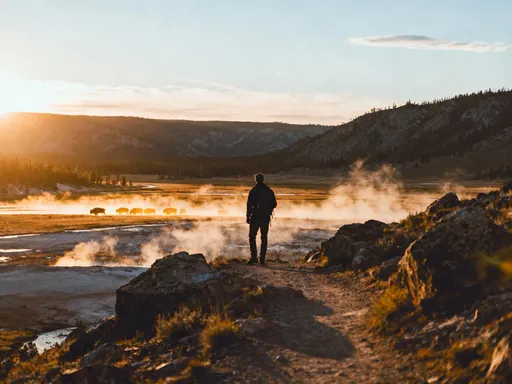
Hiking into Lamar Valley at first light offers a rare combination of solitude and spectacle. On one summer morning, I followed a dirt path along the river’s edge, camera in hand, when a massive bison herd emerged from the fog. Dozens of dark silhouettes moved slowly across the meadow, their breath visible in the cold air. A cow called softly to her calf, and the low grunts echoed across the open space. Further on, a coyote darted through the grass, pausing to sniff the wind before vanishing into the brush. These are not staged encounters; they are real, unscripted moments that unfold naturally when you’re present and patient.
The early hour enhances both visual beauty and photographic opportunity. The low angle of the sun casts long shadows and warm highlights, turning ordinary scenes into works of art. A herd of elk standing on a hillside becomes a silhouette against the rising sun. A river bend catches the light, turning the water to liquid gold. These fleeting moments are why many photographers and nature lovers time their hikes for dawn. But beyond the images, there’s a deeper reward: the sense of being alone in a vast, wild landscape, where human presence feels small and temporary. Lamar Valley at sunrise isn’t just a place—it’s a feeling, a reminder of nature’s quiet power.
To make the most of this experience, it’s essential to start hiking before 6 a.m., especially in summer when the park fills quickly. Bring binoculars or a spotting scope, as many animals stay at a distance. Wear layers, as temperatures can be near freezing in the morning, even in July. And always carry bear spray, as grizzlies are known to roam this area, particularly in spring and early summer. By preparing properly and moving quietly, you increase your chances of witnessing something unforgettable—not just wildlife, but the quiet majesty of a landscape that has changed little in centuries.
The Hidden Beauty of the Shoshone Geyser Basin
Nestled in the remote southwest corner of Yellowstone, the Shoshone Geyser Basin is one of the park’s best-kept secrets. Accessible only by foot or kayak, this backcountry gem lies about 18 miles from the nearest road, deep in the heart of the park’s wilderness. Fewer than 1% of Yellowstone visitors ever set foot here, making it a true sanctuary of solitude. The journey to reach it is part of the adventure—a full-day hike or paddle across Yellowstone Lake’s West Thumb, followed by a rugged trek through pine forests and meadows. But for those willing to make the effort, the reward is extraordinary: a sprawling thermal area with over 80 geysers, steaming fumaroles, and vividly colored hot springs, all untouched by boardwalks or crowds.
As I approached the basin, the first sign of its presence was the smell—a sharp, earthy scent of sulfur carried on the breeze. Then came the sound: a low, rhythmic chugging, like a distant steam engine. Emerging from the trees, I saw it: a valley alive with geothermal activity. Turquoise pools bubbled gently, their edges ringed with orange and green microbial mats. Mud pots gurgled and popped, throwing up globs of gray sludge. And in the distance, a geyser erupted—not the predictable Old Faithful, but a wild, spontaneous burst of water and steam with no name and no audience. It was nature in its purest form, unregulated and unrestrained.
What makes Shoshone so special is not just its beauty, but its authenticity. Unlike the developed geyser basins, where safety barriers and visitor centers shape the experience, Shoshone feels raw and untamed. You walk on natural trails, choose your own path, and stand mere feet from boiling water—always with caution. The silence is profound, broken only by the sounds of nature: the wind in the trees, the occasional call of a raven, the hiss of escaping steam. It’s easy to feel like the first person to ever see this place, even though geologists and early explorers documented it over a century ago.
Reaching Shoshone requires careful planning. A backcountry permit is mandatory, and hikers must follow strict Leave No Trace principles to protect the fragile ecosystem. Traveling in groups of four or more is recommended for bear safety, and all food must be stored in bear-resistant containers. Navigation skills are essential, as trail markers are sparse. Despite these challenges, the journey is worth it. Shoshone offers a rare chance to experience Yellowstone as it was meant to be seen—not curated, not crowded, but wild and free. For those seeking a deeper connection with the park’s geothermal heart, this hidden basin is a pilgrimage worth making.
Canyon Country: Hiking Beneath the Grand Cascade
The Grand Canyon of the Yellowstone is one of the park’s most iconic landscapes, a dramatic gorge carved by the Yellowstone River over thousands of years. While many visitors admire it from overlooks like Artist Point or Inspiration Point, hiking into the canyon offers a far more immersive experience. Trails like the Uncle Tom’s Trail and the Brink of the Lower Falls path take you down hundreds of feet into the canyon itself, placing you at eye level with the thundering falls. The descent is steep—Uncle Tom’s involves over 300 metal stairs—but the payoff is unmatched: standing on a metal platform just feet from the 308-foot Lower Falls, feeling the spray on your face and the vibration in your chest.
The power of the falls is overwhelming. Water crashes down the rust-colored cliffs with such force that the air hums. Mist rises in clouds, catching the sunlight and forming rainbows on clear days. The rock walls, stained by iron and sulfur compounds, glow in shades of red, orange, and yellow, especially at sunrise and sunset. As you stand at the brink, it’s impossible not to feel small. This is nature’s raw energy on full display—a reminder of the geological forces that shaped this entire region. The trail offers multiple vantage points, each revealing a different angle of the falls and the canyon’s layered rock formations.
While the views are breathtaking, safety is paramount. The trails in this area are well-maintained but can be slippery, especially near the water’s edge. Railings and boardwalks are in place for a reason—several people have fallen over the years by venturing too close. Park regulations require all visitors to stay on designated paths and behind barriers. The ground near thermal areas can be unstable, and the river’s current is dangerously strong. Parents should keep a close eye on children, and hikers should wear sturdy footwear with good traction. Additionally, this area can be crowded, especially in midday, so visiting early in the morning or late in the afternoon improves both safety and serenity.
For a longer hike, consider the South Rim Trail, which extends from Inspiration Point to Uncle Tom’s Trailhead, offering continuous views of the canyon and the river below. This 1.5-mile path is mostly flat and accessible, with interpretive signs explaining the geology and history of the area. It’s an excellent choice for families or those with limited mobility who still want to experience the canyon’s grandeur. Whether you take the steep descent or the scenic rim walk, hiking in the canyon transforms a postcard view into a visceral, unforgettable encounter with one of Yellowstone’s greatest wonders.
Alpine Vistas from Mount Washburn: Above the Clouds
Rising to 10,243 feet, Mount Washburn is one of the most accessible high-elevation hikes in Yellowstone, offering panoramic views that stretch for miles in every direction. The trail begins in dense forest but quickly opens into alpine meadows, where the air grows thinner and the wind stronger. As you climb, the world below unfolds—green valleys, winding rivers, and distant mountain ranges. Reaching the summit feels like standing on top of the world, with nothing but wilderness in every direction. On a clear day, you can see the Tetons to the south and the Absaroka Range to the east, a vast tapestry of peaks and forests that seems to go on forever.
One of the most memorable moments of my hike came just below the summit, as I rounded a bend and saw a herd of bighorn sheep grazing on a rocky ledge. These sure-footed animals are perfectly adapted to the steep terrain, their curved horns silhouetted against the sky. They paused, watching me with calm curiosity, before continuing their slow descent. Later, a golden eagle soared overhead, riding the thermals with effortless grace. These encounters, combined with the sweeping views, create a sense of awe that’s hard to describe. It’s not just the altitude that takes your breath away—it’s the sheer scale and beauty of the landscape.
Midsummer is the best time to hike Mount Washburn, when the snow has melted and wildflowers blanket the slopes. Lupine, paintbrush, and arnica bloom in vibrant colors, attracting pollinators and adding to the trail’s charm. However, this is also when afternoon thunderstorms are most likely. The summit is exposed, with no shelter, so hikers must monitor weather conditions and aim to descend by early afternoon. Lightning strikes are a real danger at high elevations, and the park has recorded fatalities in the past. Carrying a weather radio or checking forecasts via satellite messenger is strongly advised.
The trail itself is well-marked and maintained, but the elevation gain demands respect. Hikers should carry extra water, snacks, and layers, as temperatures can vary by 30 degrees or more between trailhead and summit. Sunscreen and sunglasses are essential—the UV exposure is intense at this altitude. Despite the challenges, Mount Washburn remains one of the most popular hikes in the park, and for good reason. It offers a rare opportunity to rise above the forest and see Yellowstone not as a collection of景点, but as a vast, interconnected ecosystem. From this height, the park’s wild heart beats clearly, and you feel a part of it.
How to Prepare for a Scenic, Safe Hike in Yellowstone
No matter which trail you choose, preparation is the key to a safe and rewarding hike in Yellowstone. The park’s remote location, unpredictable weather, and wildlife presence require careful planning. Start with the essentials: every hiker should carry bear spray, easily accessible and within its expiration date. Though bear encounters are rare, they do happen, and proper use of bear spray has proven highly effective in preventing injuries. You should also carry a map and compass or GPS device, as cell service is limited or nonexistent in most areas. A physical map and basic navigation skills can be lifesaving if you lose the trail.
Dressing in layers is critical. Yellowstone’s weather can change rapidly, with sunny mornings giving way to afternoon thunderstorms or even snow in early summer. A moisture-wicking base layer, an insulating mid-layer, and a waterproof outer shell provide flexibility for changing conditions. Sturdy hiking boots with ankle support are essential, especially on rocky or uneven terrain. Don’t forget a hat, gloves, and sunglasses—protection from sun and wind is just as important as warmth. Hydration is another priority; carry at least two liters of water per person, and bring a water filter or purification tablets to refill from streams.
Wildlife safety is a top concern. Bison are responsible for more injuries in Yellowstone than any other animal, often because visitors get too close. Always stay at least 25 yards (23 meters) from bison and 100 yards (91 meters) from bears and wolves. If an animal changes its behavior because of your presence, you’re too close. In bear country, make noise on blind turns, hike in groups, and store food properly. Backcountry campers must use bear-resistant food storage containers and hang food bags if required. Never feed or approach any wildlife—doing so endangers both you and the animals.
Finally, check trail conditions and weather forecasts before you go. The National Park Service provides up-to-date information on trail closures, snow levels, and fire restrictions. Some trails may be closed due to bear activity, flooding, or maintenance. By staying informed, you ensure a safer, more enjoyable experience. With the right preparation, every hike in Yellowstone becomes not just an adventure, but a journey into one of the last great wild places on Earth.
Hiking in Yellowstone offers a depth of experience that no other form of travel can match. It slows you down, opens your senses, and connects you to the land in a way that feels both ancient and urgent. From the quiet beauty of dawn in Lamar Valley to the thunderous power of the Lower Falls, from the hidden geysers of Shoshone to the sweeping vistas of Mount Washburn, each trail tells a story. These are not just destinations—they are moments of discovery, of wonder, of being fully present. The park’s magic lies not in its postcard views, but in the quiet spaces between them. So lace up your boots, respect the wild, and take that first step. The trail is waiting, and with it, a world you won’t believe until you see it for yourself.